Unit 1 - Lesson 1: Real Numbers and Operations
Explore irrational numbers, the real number system (R), radical simplifications, and conjugate numbers with step-by-step applications.
1. Understanding the Real Number System
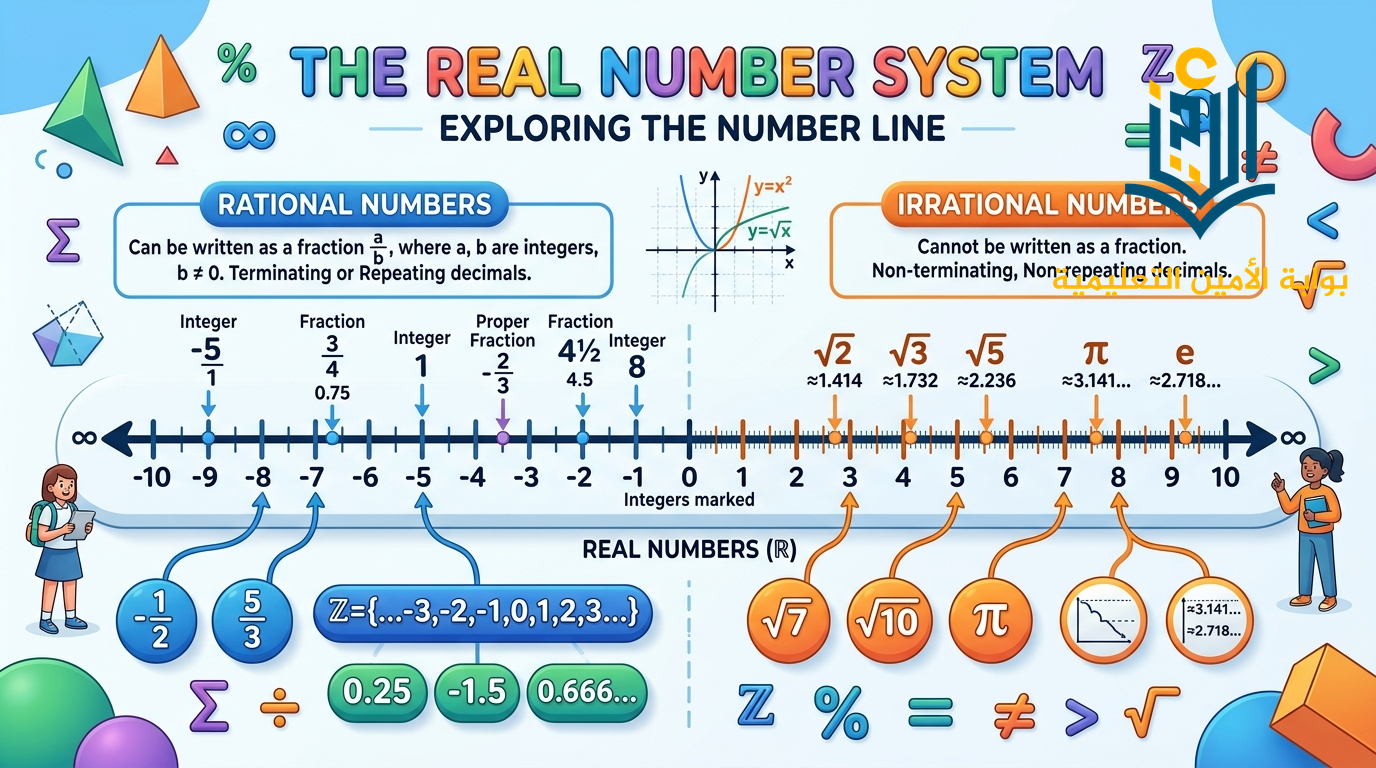
Rational Numbers (Q)
Numbers that can be expressed as a fraction a / b, where a and b are integers and b ≠ 0.
Examples: 3/4, -5, 0.25, √25 (= 5), ³√8 (= 2).
Irrational Numbers (Q')
Numbers that cannot be written as simple fractions; their decimal expansions are infinite and non-repeating.
Examples: √2, √3, √5, ³√7, and the constant π.
Definition of Real Numbers (R):
The set of Real Numbers R is the union of Rational Numbers and Irrational Numbers:
Every point on the real number line represents exactly one real number, and every real number corresponds to a unique point.
2. Radical Properties & Simplifying Radicals
Example: √12 = √(4 × 3) = 2√3
Example: √(50 / 2) = √25 = 5
Example: (√7)² = 7
Rationalizing Denominators & Conjugates:
1. Single radical in denominator: Multiply both numerator and denominator by that radical:
2. Conjugate Numbers: The product of two conjugates always eliminates the radical:
3. Interactive Worked Exercises
Solution Steps:
1) √18 = √(9 × 2) = 3√2 ⇒ 2√18 = 2 × 3√2 = 6√2
2) √50 = √(25 × 2) = 5√2
3) Total = 6√2 + 5√2 - 4√2 = (6 + 5 - 4)√2
Final Answer = 7√2
Solution Steps:
Multiply numerator and denominator by the conjugate (√5 + 1):
Denominator = (√5 - 1)(√5 + 1) = 5 - 1 = 4
Numerator = 8(√5 + 1)
Fraction = 8(√5 + 1) / 4 = 2(√5 + 1)
Final Answer = 2√5 + 2
4. Interactive Assessment Quiz
Choose the correct answer for each question, then click "Submit Answers":
التعليقات والمناقشة