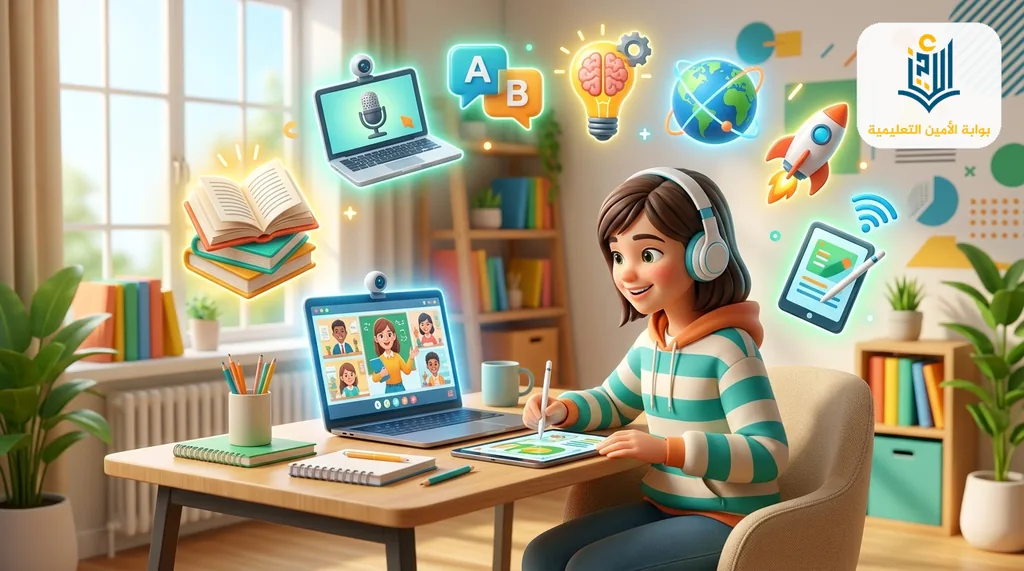
A Day in My Digital Life: Navigating Technology and Daily Routines
Modern teenagers inhabit a world fundamentally shaped by interconnected digital technology. From morning alarms programmed on smart devices to interactive educational platforms and digital assignments, technology permeates every facet of daily student life. However, maintaining equilibrium between virtual engagement and real-world responsibilities requires intentional screen time management and acute awareness of one's digital footprint. In this opening lesson, we explore a typical day in the life of a digitally literate middle school student, analyzing how technological collocations, daily routines, and grammatical precision in contrasting the present simple and present continuous tenses illuminate our connected existence.
1. Reading Context: Ziad's Connected Day
Thirteen-year-old Ziad wakes up at 6:30 AM to a soothing melodic chime generated by his smart alarm clock. Before getting dressed for school, he does not waste time scrolling passively through video feeds; instead, he checks his school portal for updates regarding his science project. "My teachers upload our research guidelines to the cloud," Ziad explains. "This helps us prepare our materials collaboratively."
Throughout the morning, Ziad attends lessons in mathematics, English, and computer science. While his classmates are currently designing a website in the computer laboratory, Ziad is typing code for an interactive quiz. In the afternoon, Ziad practices basketball with his school team, intentionally setting his smartphone to 'Do Not Disturb' mode. He recognizes that healthy physical exercise and direct human interaction are just as vital as digital literacy.
Core Takeaway: Healthy Digital Balance
Productive digital citizens utilize technology as an empowering academic tool while strictly capping recreational screen time to protect physical health and sleep hygiene.
2. Essential Technology Collocations
In the English language, specific verbs naturally combine with technological nouns. Using precise collocations demonstrates authentic language mastery:
| Collocation | Syntactic Function | Contextual Sentence |
|---|---|---|
| check notifications | Verb + Plural Noun | Nour checks her notifications twice a day to avoid constant distractions. |
| stream a video | Verb + Singular Noun | We are streaming an educational documentary about marine ecosystems. |
| set a password | Verb + Direct Object | You must set a complex password containing letters, digits, and symbols. |
| upload an assignment | Verb + Direct Object | The students uploaded their English essays before the midnight deadline. |
| recharge a battery | Verb + Direct Object | He plugged in his tablet to recharge the battery overnight. |
| browse the web | Verb + Direct Object | Laila browses reliable scientific encyclopedias for her biology report. |
3. Grammar Focus: Present Simple vs. Present Continuous
Mastering the distinction between ongoing temporary actions and permanent habitual facts is fundamental to fluent English communication:
Present Simple
Used for routines, general truths, scheduled timetables, and permanent situations.
- Form: Base Verb (add -s/-es for he/she/it).
- Key Adverbs: always, usually, often, sometimes, rarely, every day.
- Example: Sami uses his tablet for studying every evening.
Present Continuous
Used for actions happening now, temporary situations, or emerging trends.
- Form: am / is / are + Verb-ing.
- Key Signals: now, at the moment, currently, look!, listen!, today.
- Example: Sami is participating in a live online seminar at the moment.
Practical Application & Language Workshop
Activity 1: Analytical Reading Comprehension
Based on Ziad's day, explain why he activates 'Do Not Disturb' mode during his basketball training, and identify how his digital habits demonstrate self-discipline.
Activity 2: Grammatical Aspect Discrimination
Correct the grammatical error in the following sentence: "Hala is usually doing her research on the library computer, but today she uses her brother's laptop."
Tap any card to reveal its meaning, or tap the audio icon to listen:
Click on an option to check your answer and view the detailed explanation: