Unit 1 - Lesson 1: Structure of the Atom
Explore the microscopic architecture of matter, Rutherford's atomic model, subatomic particles (protons, neutrons, electrons), and chemical symbols.
Audio Science Tutor
Listen to an audio walkthrough of atomic structure and subatomic particles
1. Matter and the Fundamental Building Unit
Everything surrounding us in nature is considered Matter. Matter has mass and occupies space.
From Grand Monuments to Atoms
The Great Sphinx is carved from limestone rock → Limestone consists of calcium carbonate substance → Calcium carbonate consists of molecules → Each molecule is composed of individual Atoms.
The Atom
The Atom is the fundamental building and structural unit of all matter. Chemical reactions occur through the interactions of atoms.
Historical Discoveries of the Atom
Democritus
Ancient Greek philosophers proposed that matter consists of minute, indivisible particles termed "atomos" (uncuttable).
John Dalton
Formulated the first modern scientific atomic theory, positing that elements consist of solid, indivisible atoms.
Ernest Rutherford
Conducted the gold-foil experiment and built the first experimental model showing a tiny central nucleus orbited by electrons.
2. The Subatomic Components
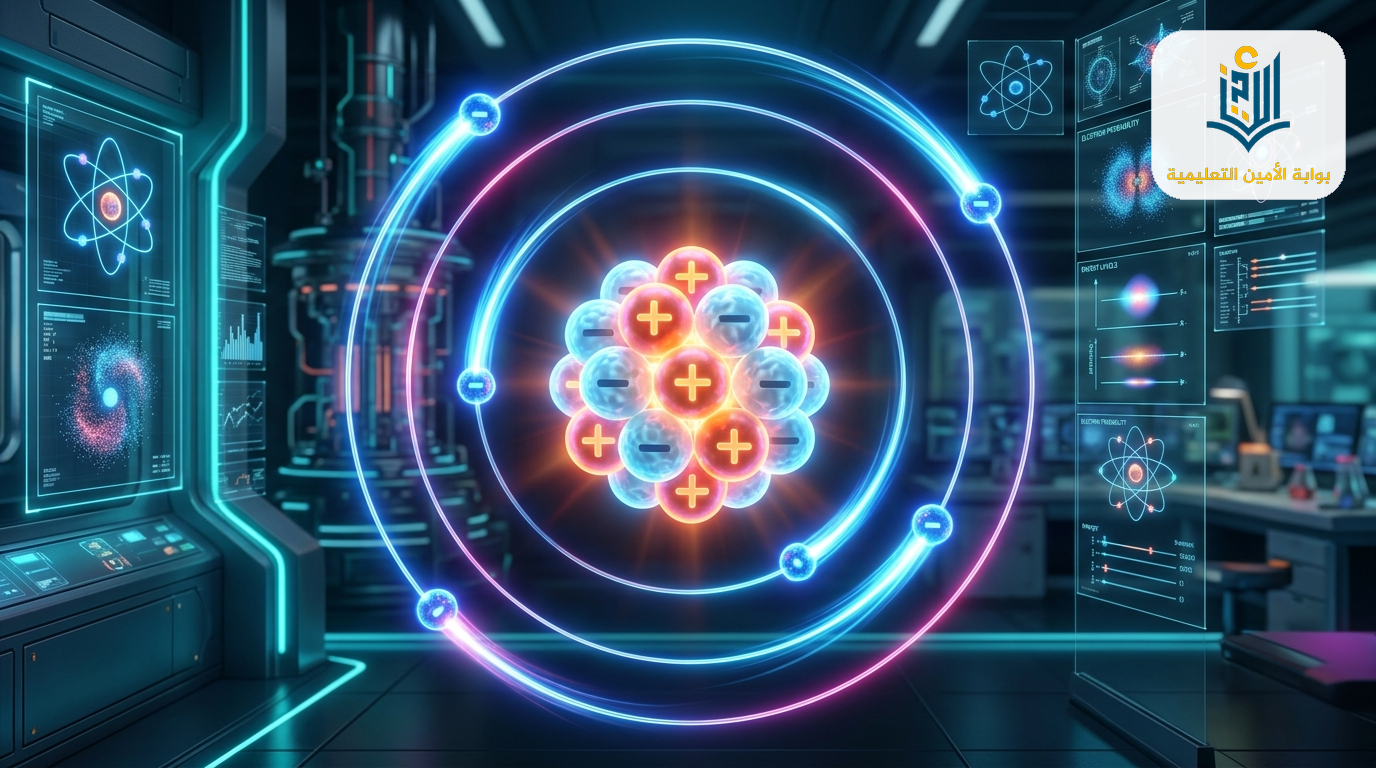
An atom is divided into two primary regions: the central Nucleus and orbiting Electrons.
| Particle | Symbol | Location | Relative Charge | Relative Mass |
|---|---|---|---|---|
| Proton | p | Inside Nucleus | +1 (Positive) | 1 u |
| Neutron | n | Inside Nucleus | 0 (Neutral) | 1 u |
| Electron | e- | Energy Levels (Orbits) | -1 (Negative) | 1 / 1836 u (Negligible) |
Key Scientific Reasoning (Give Reasons)
Q1: Why is the atomic nucleus positively charged?
Answer: Because the nucleus contains positively charged protons (+1) and electrically neutral neutrons (0).
Q2: Why is the atom's mass almost entirely concentrated in the nucleus?
Answer: Because the mass of revolving electrons is extremely small (1/1836 u) and negligible compared to the mass of protons and neutrons located inside the nucleus.
Q3: Why is an atom electrically neutral in its normal ground state?
Answer: Because the number of positive protons inside the nucleus is exactly equal to the number of negative electrons revolving around it.
3. Chemical Symbols of Elements
Scientists use standard chemical symbols to represent a single atom of an element. Symbols are derived from English or historical Latin names:
English Name Matches Latin
- Carbon (Carbo) C
- Nitrogen (Nitrogenium) N
- Chlorine (Chlorum) Cl
- Chromium (Chromium) Cr
Latin Name Differs from English
- Sodium (Natrium) Na
- Potassium (Kalium) K
- Copper (Cuprum) Cu
- Iron (Ferrum) Fe
4. Interactive Subatomic Particle Explorer
Click any subatomic particle to inspect its physical properties, charge, and role in the atom
Proton
+1 Relative ChargeProtons are heavy subatomic particles that reside inside the nucleus. Their total number defines the Atomic Number of an element and determines its chemical identity.
5. Knowledge Check & Mastery Quiz
5 questions to evaluate your understanding of the atomic structure. Choose the correct option:
التعليقات والمناقشة