Unit 1 - Lesson 1: States of Matter and Molecular Motion
Explore the microscopic structure of matter: intermolecular spaces, intermolecular forces, molecular movement, and thermal phase transitions.
1. Comparative Study: The Three States of Matter
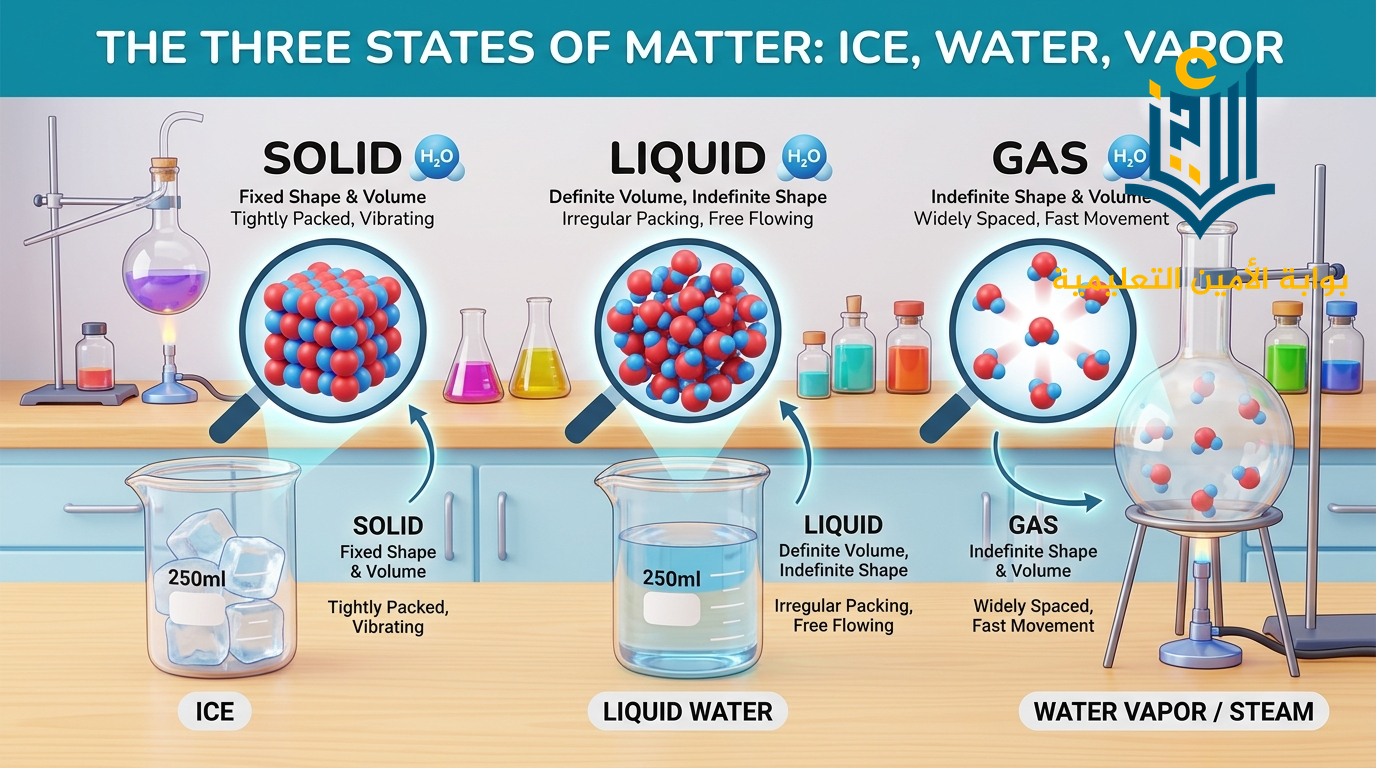
The physical state of any substance depends mainly on two microscopic factors: intermolecular spaces and intermolecular forces:
| Comparison Point | Solid State (e.g. Iron, Ice) | Liquid State (e.g. Water, Alcohol) | Gaseous State (e.g. Oxygen, Steam) |
|---|---|---|---|
| Shape and Volume | Definite shape and definite volume | Indefinite shape (takes container's shape) and definite volume | Indefinite shape and indefinite volume (compressible) |
| Intermolecular Spaces | Extremely narrow (almost negligible) | Relatively large (intermediate) | Very large (maximum) |
| Intermolecular Forces | Extremely strong (maximum) | Relatively weak | Almost non-existent (negligible) |
| Molecular Motion | Vibrational in fixed positions | More free (glide over one another) | Completely free (random motion in all directions) |
2. Thermal Energy and Phase Transitions
1. Melting Process
Transition of a substance from solid state to liquid state by heating.
What happens? Molecules absorb thermal energy, their speed increases, intermolecular spaces expand, and intermolecular forces weaken, allowing molecules to move more freely.
2. Vaporization (Boiling)
Transition of a substance from liquid state to gaseous state by heating.
What happens? Molecules gain higher kinetic energy, overcome intermolecular forces completely, and escape freely into the air as gas.
Give Reason Scientific Questions:
- Give reason: Solids have a definite shape and volume? → Because intermolecular spaces are very small and intermolecular forces are extremely strong.
- Give reason: Gases have no definite volume or shape? → Because intermolecular spaces are very large and intermolecular forces are almost non-existent.
3. Interactive Assessment Quiz
Choose the correct answer for each question, then click "Submit Answers":
التعليقات والمناقشة