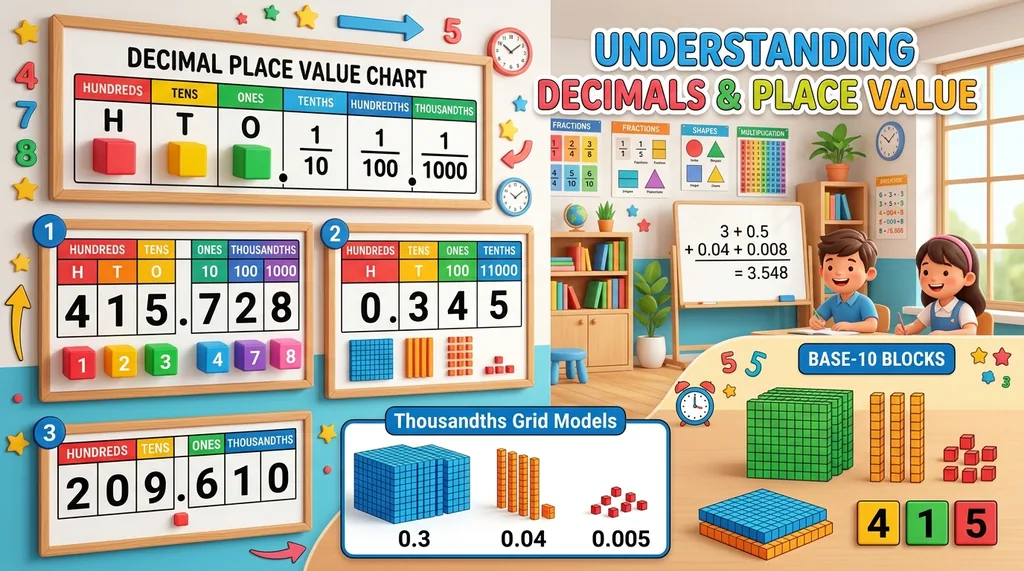
Decimal Place Value: Representing, Reading, and Writing Decimals to the Thousandths
The base-ten positional numeration system extends seamlessly beyond whole numbers to represent fractional quantities of immense precision. In fifth-grade mathematics, students venture past tenths and hundredths into the realm of thousandths, where each unit is partitioned into one thousand equal parts. Understanding that a digit's value is fundamentally determined by its position relative to the decimal point is essential for mathematical fluency. Through place value charts, decimal grids, and three standard representational formats—standard form, word form, and expanded form—learners deconstruct complex decimal values. By mastering the relationships between fractional representations such as 1/1000 and decimal forms like 0. 001, students establish a rigorous numerical foundation for advanced scientific measurement and everyday computation.
1. The Decimal Place Value Chart
In our base-ten number system, moving one position to the left multiplies a digit's value by 10, whereas moving one position to the right divides its value by 10 (or multiplies by 1/10). The decimal point acts as the separator between whole units and fractional parts:
| Whole Number Part | Separator | Decimal Part (Fractional) | |||
|---|---|---|---|---|---|
| Tens (10) | Ones (1) | Decimal Point | Tenths (0.1 = 1/10) | Hundredths (0.01 = 1/100) | Thousandths (0.001 = 1/1000) |
| 4 | 7 | . | 3 | 8 | 5 |
In the number 47.385: the digit 4 is in the tens place (value = 40), 7 is in the ones place (value = 7), 3 is in the tenths place (value = 0.3), 8 is in the hundredths place (value = 0.08), and 5 is in the thousandths place (value = 0.005).
2. Standard, Word, and Expanded Forms
A decimal number can be represented in three mathematically equivalent formats:
1. Standard Form
Written purely with numerical digits and a decimal point: 5.429
2. Word Form
Read the whole number part, say 'and' for the decimal point, read the fractional part as a whole number, and state the place value of the last digit: "Five and four hundred twenty-nine thousandths"
3. Expanded Form
Expressed as the sum of the values of each individual digit:
- Decimal Expanded: 5 + 0.4 + 0.02 + 0.009
- Fractional Expanded: 5 + (4 × 1/10) + (2 × 1/100) + (9 × 1/1000)
3. Place Value vs. Value of a Digit
Students must strictly distinguish between where a digit lives (its place value) and how much that digit is worth (its value):
| Decimal Number | Target Digit | Place Value (Location) | Value of the Digit (Worth) |
|---|---|---|---|
| 12.604 | 4 | thousandths | 0.004 (or 4/1000) |
| 8.391 | 3 | tenths | 0.3 (or 3/10) |
| 25.078 | 7 | hundredths | 0.07 (or 7/100) |
Practical Application & Math Workshop
Activity 1: Decomposing Decimals into Expanded Form
Write the decimal 16.708 in: (a) word form, and (b) fractional expanded form.
(a) Word Form: "Sixteen and seven hundred eight thousandths."
(b) Fractional Expanded Form: 10 + 6 + (7 × 1/10) + (8 × 1/1000). Note: Since the hundredths digit is 0, it contributes 0 to the sum.
Activity 2: Value Determination
If the digit 9 is moved from the hundredths place to the tenths place, how does its mathematical value change?
Tap any card to reveal its meaning, or tap the audio icon to listen:
Click on an option to check your answer and view the detailed explanation: