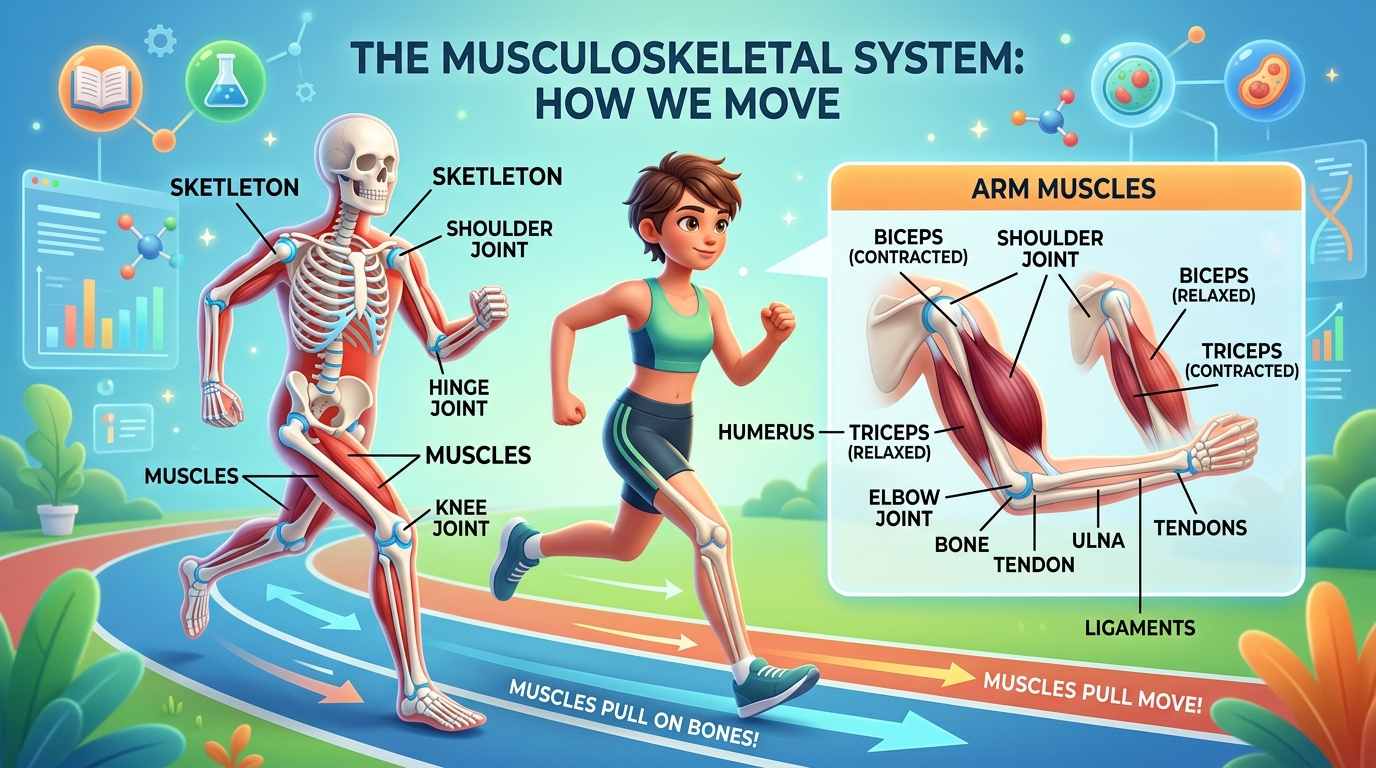
Lesson 1: Bones and Muscles
Have you ever wondered how you run fast, jump high, or bend your arm? Discover the amazing teamwork between hard bones and flexible muscles that powers every move you make!
What You Will Learn:
1. The Cooperation of Bones and Muscles
What is Meant by Muscles?
Muscles are soft body parts that cause the movement of bones.
-
Location: Muscles are located directly under the skin and cover almost all parts of the human body.
-
Function: Muscles help the body to move because they PULL the bones attached to them. (Remember: muscles can only pull bones, they never push them!).
Hard & Strong Bones
Provide internal structure, support the body weight, and protect vital organs.
Flexible & Soft Muscles
Contract and relax to generate force and pull bones to create motion.
The Joint (المفصل)
The meeting place where bones connect and bend, enabling smooth motion.
2. How Muscles Work: Contraction & Relaxation
Muscle Contraction (انقباض)
What happens?
- The muscle becomes shorter.
- The muscle becomes more hard (harder).
- It pulls the bone attached to it towards itself.
Muscle Relaxation (ارتخاء)
What happens?
- The muscle becomes longer.
- The muscle becomes less hard (softer).
- It returns to its normal resting state.
3. Interactive Arm Simulator: Muscles Work in Pairs!
Click the buttons below to bend or stretch the arm and watch how the inner and outer muscles respond!
Inner Muscle (Front / Biceps)
Pulls the lower arm upward at the elbow joint.
Outer Muscle (Back / Triceps)
Yields and allows the inner muscle to pull the forearm.
Because muscles can only pull bones, never push. To move a bone in opposite directions, one muscle must pull while the opposite muscle relaxes!
Interactive Science Quiz
Test your understanding of bones, muscles, and joint movements
التعليقات والمناقشة