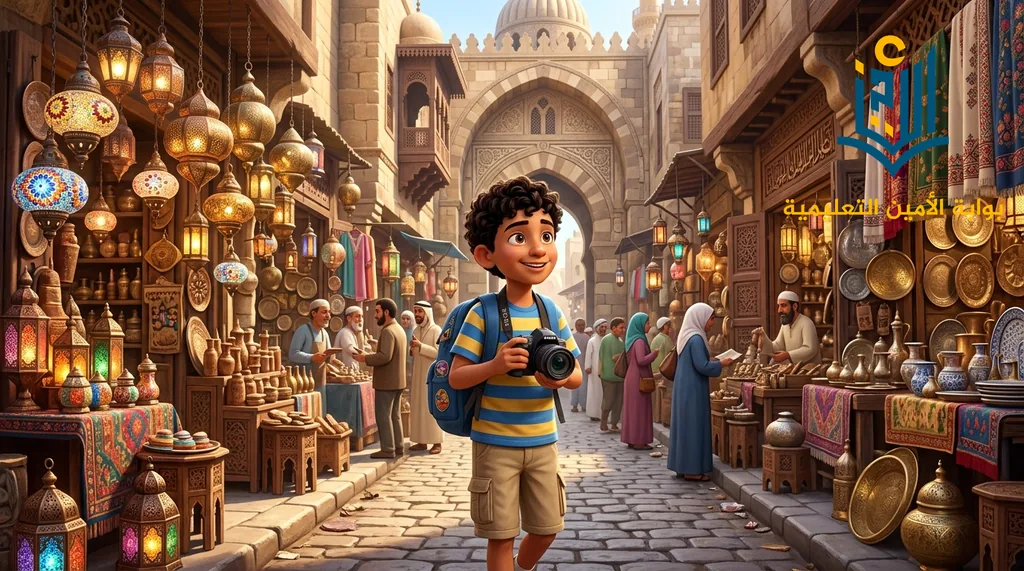
A Day in Egypt: Cairo Citadel, Khan el-Khalili, and Desert Oases
Egypt is an extraordinary land where thousands of years of vibrant civilization meet breathtaking natural landscapes. From the majestic stone ramparts of the Citadel of Saladin overlooking the bustling metropolis of Cairo, to the aromatic, winding alleys of Khan el-Khalili market, every corner tells a compelling story of human creativity. Further west, nestled among vast sand dunes in the Western Desert, the peaceful oasis of Siwa enchants travelers with its date palm groves, natural freshwater springs, and ancient mud-brick ruins of the Shali fortress. In this foundational lesson, sixth-grade students explore iconic cultural landmarks, acquire rich travel and heritage lexicon, and master the fundamental distinction between the Present Simple tense for enduring geographic facts and the Past Simple tense for memorable historical journeys.
1. Exploring Iconic Egyptian Heritage Sites
Egypt boasts a wealth of historical monuments that attract travelers and historians from across the globe. Three distinctive destinations capture Egypt's rich cultural variety:
The Cairo Citadel
Built by the medieval commander Salah al-Din in the 12th century on the Mokattam Hills, this fortified citadel protected the city from invaders. It houses the magnificent Mosque of Muhammad Ali with its soaring alabaster minarets.
Historic FortressKhan el-Khalili
A historic commercial bazaar founded in the 14th century in Islamic Cairo. Its labyrinthine pathways are lined with artisan workshops producing handmade brass lamps, silver filigree, colorful spices, and leather goods.
Traditional BazaarSiwa Oasis
Located in the Western Desert near the Libyan border, Siwa is an isolated paradise famous for its thermal springs, lush olive orchards, ancient Shali fortress built of kershef (salt-mud), and towering dunes of the Great Sand Sea.
Desert Oasis2. Thematic Lexicon & Travel Terminology
Developing accurate descriptive vocabulary allows students to discuss tourist sites and historical landmarks with precision:
| Term | Syntactic Role | Contextual Definition & Usage |
|---|---|---|
| citadel | Noun | A fortified stronghold built on high ground to defend a strategic city. |
| bazaar | Noun | A traditional Middle Eastern marketplace consisting of rows of shops and stalls. |
| oasis | Noun (pl. oases) | A fertile tract in a desert supplied with water by natural subterranean springs. |
| minaret | Noun | A tall, slender tower attached to a mosque from which the call to prayer is announced. |
| dune | Noun | A hill or ridge of loose wind-blown sand shaped by desert winds. |
| souvenir | Noun | A memorable keepsake purchased to remind a traveler of a special destination. |
3. Grammar Mechanics: Present Simple vs. Past Simple
When discussing travel and geography, choosing the correct grammatical tense is essential for conveying time orientation:
Present Simple: Enduring Facts
Used for geographic facts, unchanging truths, and permanent characteristics:
- The Cairo Citadel stands majestically on the Mokattam Hills.
- Siwa Oasis contains hundreds of freshwater springs.
- Khan el-Khalili attracts thousands of visitors every week.
Past Simple: Specific Completed Journeys
Used for completed travel experiences and specific historical narratives:
- Last winter, our class visited the Mosque of Muhammad Ali.
- Saladin built the fortified walls between 1176 and 1183 AD.
- We climbed the sand dunes in Siwa at sunset yesterday.
Practical Application & Language Workshop
Activity 1: Analytical Reading Comprehension
Compare the main architectural materials used in the Cairo Citadel with those used in the historic fortress of Shali in Siwa Oasis.
Activity 2: Grammatical Tense Discrimination
Select the appropriate verb forms: "Every summer, tourists (visit / visited) Siwa Oasis, but last July our family (travels / traveled) there by four-wheel drive."
Tap any card to reveal its meaning, or tap the audio icon to listen:
Click on an option to check your answer and view the detailed explanation: