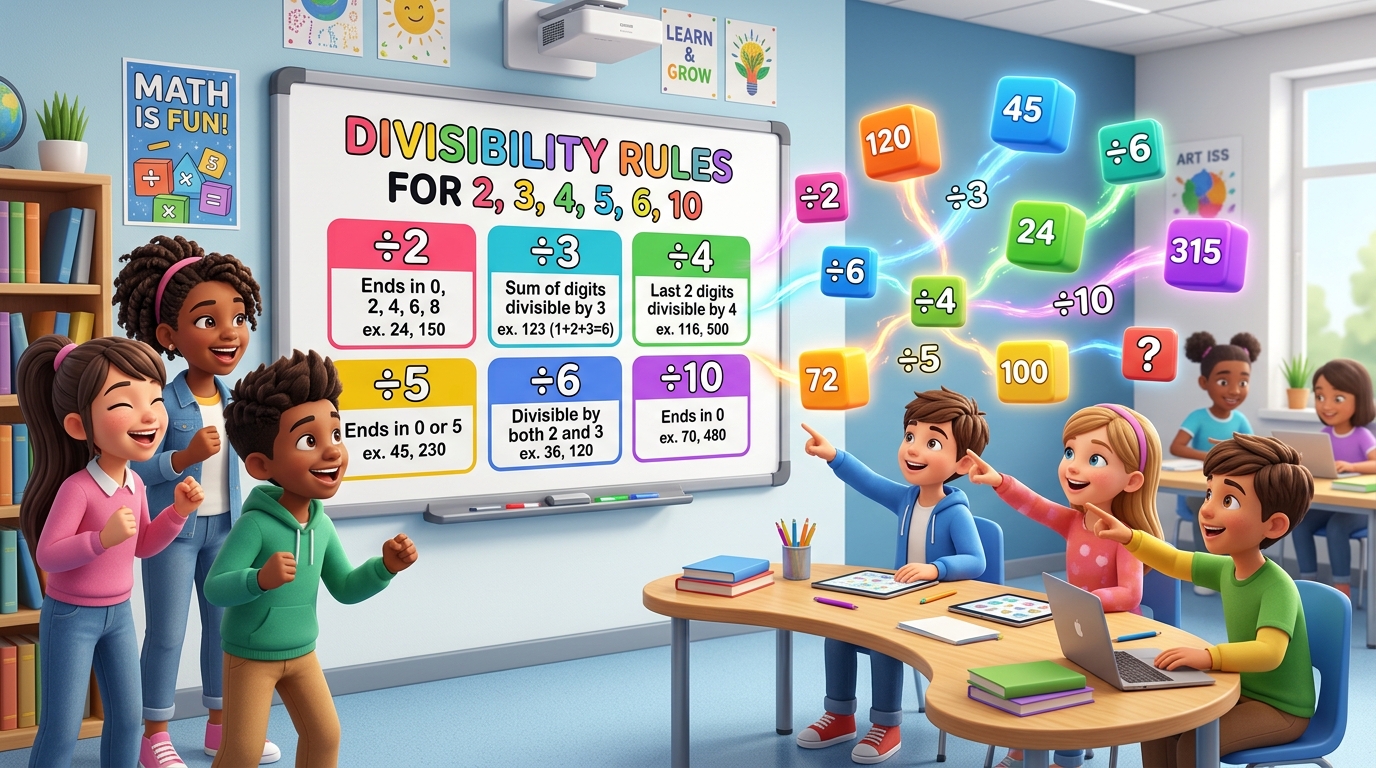
Lesson 1: Divisibility Rules
Learn how to quickly determine whether any large number is divisible by 2, 3, 4, 5, 6, and 10 without doing long division, through interactive tools, engaging examples, and challenging quizzes!
Interactive Math Audio Reader
Clear American English voice explaining math rules and concepts step-by-step
1. What is Divisibility?
General Definition:
A number is divisible by another number if the remainder of the division is zero (Remainder = 0).
Example A: Divisible
15 ÷ 3 = 5 (Remainder = 0)
Since the remainder is 0, 15 is divisible by 3. You can distribute 15 candy bars equally among 3 friends (5 bars each) with nothing left over.
Example B: NOT Divisible
13 ÷ 3 = 4 (Remainder = 1)
Since the remainder is 1, 13 is NOT divisible by 3. If you try to give 13 balloons to 3 friends, each gets 4 and 1 balloon remains!
2. The 6 Essential Divisibility Rules
Divisibility by 2
A number is divisible by 2 if its ones digit is even: 0, 2, 4, 6, or 8.
Divisibility by 3
A number is divisible by 3 if the sum of all its digits is divisible by 3.
Divisibility by 4
A number is divisible by 4 if the last two digits (ones & tens) form a number divisible by 4 or are 00.
Divisibility by 5
A number is divisible by 5 if its ones digit is 0 or 5.
Divisibility by 6
A number is divisible by 6 if it is divisible by BOTH 2 AND 3 (it is even and sum of digits is a multiple of 3).
Divisibility by 10
A number is divisible by 10 if its ones digit is 0.
3. Interactive Divisibility Lab
Type any whole number into the box below and click "Check Divisibility" to see how each rule applies in real time!
التعليقات والمناقشة