Lesson 1: How Things Burn and Air
Discover the science behind combustion, investigate why fires need oxygen to survive, and explore the candle experiment through an interactive virtual lab!
Interactive Science Audio Reader
Clear narration with distinct dialogue voices for Omar and Dr. Farida
1. What is Burning (Combustion)?
Atmospheric air is all around us everywhere, even though it is invisible to our eyes. This atmospheric air plays a fundamental role in life on Earth, including the process of burning (also scientifically known as combustion).
Scientific Definition: Burning (Combustion)
Burning is a chemical reaction (combination) that occurs between oxygen gas in the air and a substance (fuel), producing heat and light.
1. Fuel (Substance)
Wood, candle wax, coal, or gas that can react with oxygen.
2. Oxygen (Air)
The vital gas present in the atmosphere that supports combustion.
3. Heat Energy
Ignition temperature required to start the chemical reaction.
2. The Role of Air in Burning Things
To examine how air affects the continuation of burning, scientists perform the classic candle experiment using a bottomless glass cylinder.
Materials & Tools:
- A small candle (the fuel source)
- Modeling clay (to fix the candle on the board)
- Wooden board (stable working surface)
- Bottomless glass jar (open at both top and bottom)
- Metal lid (to close the top opening)
- Lighter (Caution: Used by teacher only!)
Key Experimental Cases:
Case 1: Fully Closed Jar
Covering candle with jar and sealing the top with the metal lid. Result: Flame gradually weakens and goes out quickly!
Case 2: Closed Top with Small Bottom Gap
Small gap in the clay at the bottom, but lid sealed on top. Result: Flame flickers and goes out after slightly longer time!
Case 3: Open at Both Top and Bottom
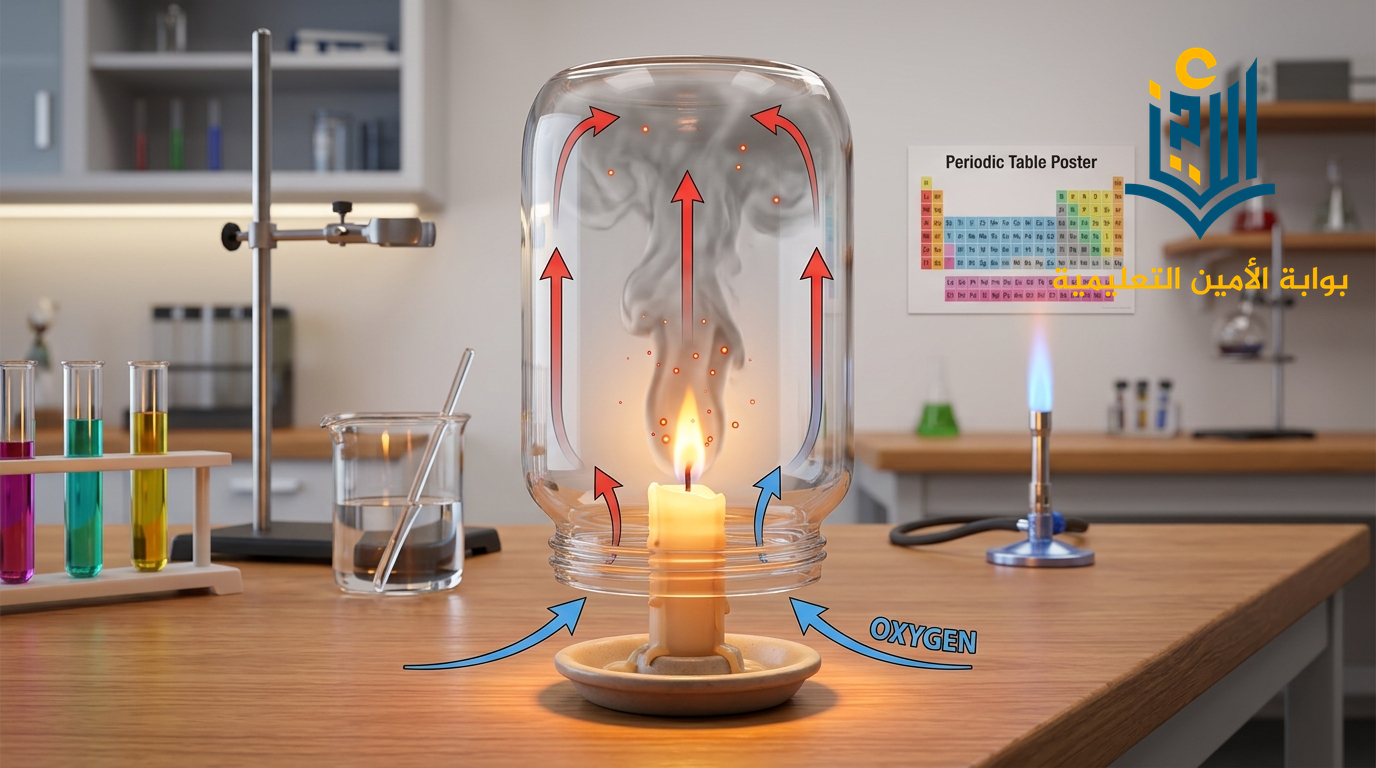
Bottom has gaps and top lid removed. Result: Fresh air constantly enters from bottom and leaves through top; flame burns continuously!
Scientific Scientific Explanation
When Jar is Sealed:
The oxygen gas inside the jar is quickly used up by the flame. Once the available oxygen runs out, the combustion reaction stops and the candle goes out.
When Both Ends are Open:
Hot air rises and exits through the top opening, creating a natural convection current that draws cool, fresh air rich in oxygen through the bottom gaps.
3. Interactive Virtual Lab
Test different jar configurations and observe the candle flame live!
Choose an experimental setup to observe:
4. Lab Discussion: Omar & Dr. Farida
Omar (Student):
"Dr. Farida, when we covered the candle with the closed jar, why did the flame go out? The jar was not empty; it had air inside!"
Dr. Farida (Science Teacher):
"Excellent question, Omar! The flame consumes oxygen during burning. In a sealed jar, that limited oxygen is completely used up. Without fresh oxygen continuously coming in, the fire cannot keep burning."
Omar (Student):
"So is that why firefighters use fire blankets to extinguish small kitchen fires?"
Dr. Farida (Science Teacher):
"Exactly! Covering the fire with a thick blanket or sand stops oxygen from reaching the burning fuel, quickly smothering the flames."
5. Scientific Vocabulary & Key Facts
| English Scientific Term | المصطلح بالعربية | Scientific Meaning |
|---|---|---|
| Combustion (Burning) | الاحتراق | Chemical combination between oxygen and a substance yielding heat and light. |
| Oxygen Gas | غاز الأكسجين | The atmospheric component that actively supports burning. |
| Convection Current | تيار الحمل الحراري | Rising of warm air and entry of fresh cool air to replenish oxygen. |
| Bottomless Jar | وعاء زجاجي مفتوح الطرفين | Glass tube open at both ends to control and observe airflow. |
| Extinguish | ينطفئ / يُخمد | To stop a fire or flame by eliminating one condition of burning. |
6. Scientific Knowledge Challenge
Answer all 5 questions to test your understanding of burning and air!
التعليقات والمناقشة